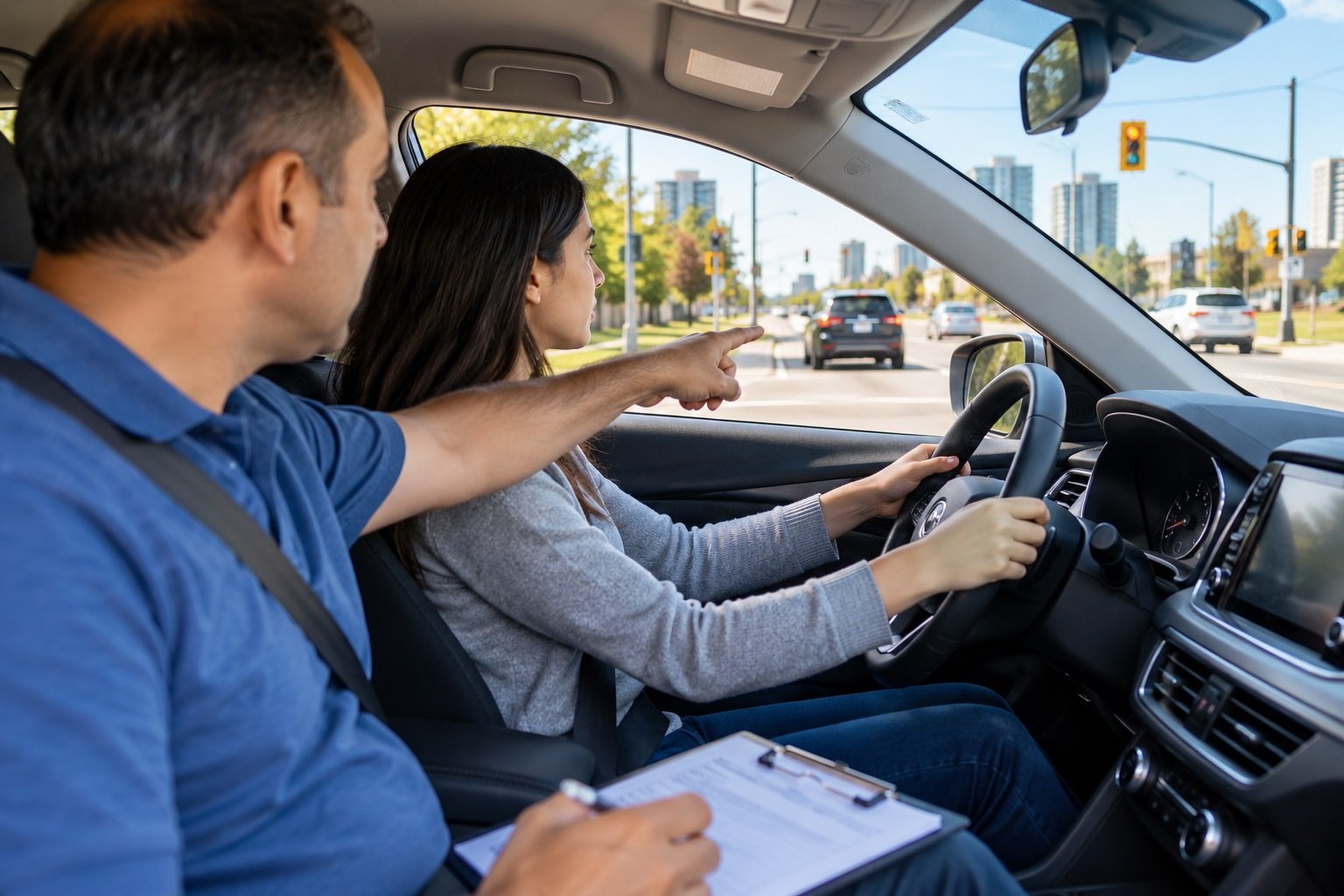
Intersections can be some of the most confusing parts of driving for new drivers. Something that helps you understand who should proceed first, how to avoid common collisions and when you must stop or yield is through Ontario right-of-way rules. Still, you can’t proceed without checking that the intersection is safe despite having the right-of-way. Before entering an intersection and yielding when necessary, Ontario’s official driving guidance emphasizes scanning for vehicles, pedestrians, and cyclists.
What does Right-of-Way Mean?
When the paths conflict, then deciding which road user should proceed is right-of-way. The situations are established by Ontario Intersection rules, where one driver must give way to another.
For instance, the driver approaching from the left must yield to the vehicle approaching from the right if two vehicles arrive at an uncontrolled intersection at the same time.
No one thinks to drive aggressively by considering a right-of-way license to drive roughly in an unwanted manner. Check all directions and be prepared for another road user to make a mistake by slowing down wherever it’s necessary.
Uncontrolled Intersection Rules in Ontario
There are no yield signs, stop signs or traffic lights in uncontrolled Intersections. you must yield if another vehicle reaches the Intersection before you. The vehicle on the right has the right-of-way, meaning the driver on the left must wait if two vehicles arrive at approximately the same time if two vehicles arrive at approximately the same time.
Suppose vehicle A and B arrive at the Intersection together. Vehicle B is on the right of vehicle A. Then, A must let vehicle B proceed before entering.
Allowing the other vehicle by slowing down to proceed can help prevent a collision when there’s uncertainty.
Stop Signs and Four-Way Stops
At a stop sign, you have to bring your vehicle to a complete stop before you can go ahead. If there is a marked stop line, bring your car to a complete stop right on that line. But if there is no stop line, then you’ll need to refer to Ontario’s traffic guidelines which specify the stopping position based on where the crosswalk is, any nearby sidewalks, and whether you’re at a four-way stop or not
At a four-way stop, the first car to stop completely is generally the one that gets to go first. But if two cars manage to come to a complete stop at the same time, you know the drill and the one on the left has to give in to the driver on the right.
Yield Sign Rules
A yield sign is not just a polite suggestion, it’s the law. When you see a yield sign, slow down and look around to make sure it’s safe to proceed, allowing other traffic on the intersecting road or in the intersection to get through first.
Don’t treat a yield sign like a ‘maybe’ sign. When approaching a yield sign, take a proper look at any oncoming traffic, cyclists and pedestrians before you decide what to do next.
Left Turn Right-of-Way in Ontario
Making a left turn is a bit more complicated because you do have to worry about oncoming traffic.
When turning left, you have to give way to any approaching vehicles and pedestrians that might be right in your path. Make sure you signal, check your surroundings carefully and only turn when it is safe and clear to do so. Since you never know what other drivers might be doing.
Here’s an example: You’re heading through an intersection on a green light and you want to turn left, but there’s a car heading straight through the intersection in front of you. You have to sit tight and wait for that car to go past before you can turn.
Right Turn Right-of-Way
When making a right turn, be aware of pedestrians and cyclists, as they might be crossing or approaching in your path. Ontario rules advise drivers to take a look in their rearview mirror and also check their right blind spot before turning.
Pedestrian Right-of-Way
Pedestrians have right of way in Ontario, especially at intersections and places where they have designated crossings.
When turning drivers have to give way to any pedestrians who are right in their path and at places like school crossings where there are crossing guards, you have to stop and stay stopped until any pedestrians have cleared the road and are safely on the other side.
Cyclist Right-of-Way
Cyclists are just as much road users as any other drivers out there, so you need to keep an eye out for them at intersections.
When making a right turn, check your right blind spot so that you don’t accidentally turn across a cyclist’s path. And when making a left turn, wait until any oncoming cyclists have had a chance to pass before you turn.
Traffic Light Right-of-Way
Just because the light is green and you can go, it doesn’t mean you ignore all other road users . When you get a green light, drivers turning left or right have to give way to any vehicles or pedestrians already in the intersection, or crossing their path. That’s just basic courtesy
A yellow light is a warning to slow down and see if you can stop safely before the light turns red. Red lights mean a complete stop.
Common Intersection Mistakes in Ontario
- Turn right without checking for cyclists.
- Ignore pedestrians while making turns.
- Enter an intersection when traffic ahead is blocking the exit.
- Assume using a turn signal gives them the right-of-way.
- Assume a green light means they automatically have priority.
- Fail to make a complete stop at a stop sign.
- Forget the right-hand rule at uncontrolled intersections.
- Turn left in front of approaching traffic.
If you want professional driving training and a thorough understanding of Ontario’s driving rules, it is better to enroll in one of the best driving schools in Mississauga.