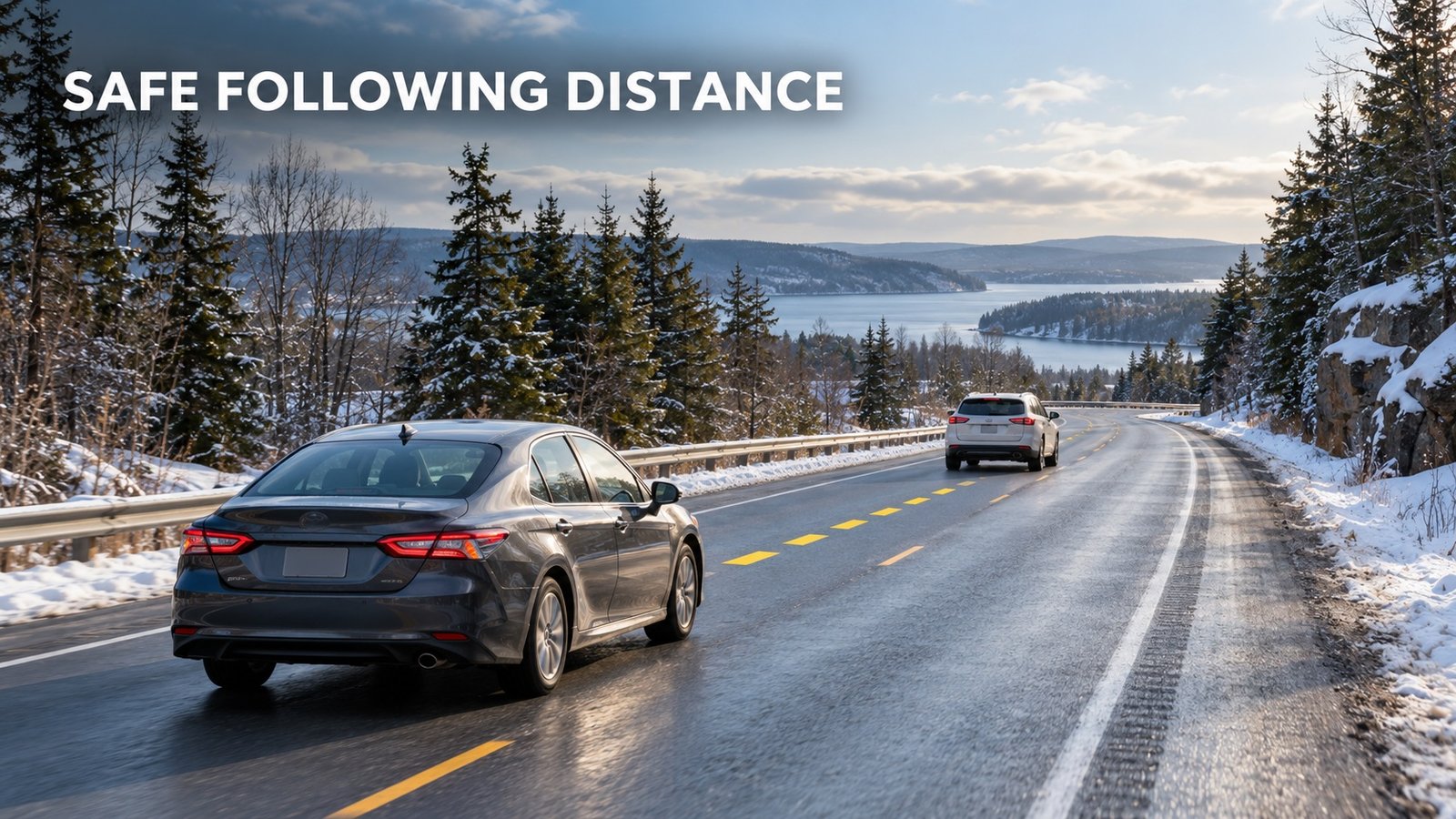
Safe following distance gives you time to see a hazard, react and slow down before an accident. That space counts on Highway 401, at a country crossroads or in neighborhood traffic.
Things move fast in Ontario. Rain can freeze. Snow can melt and refreeze after dark. A snow squall can reduce vsibility to nil in minutes.
The Ontario Driver’s Handbook suggests a two-second following distance in perfect conditions. A starting point, the gap must be appropriate for your speed, vision, traction and vehicle load. Ontario Driver’s Handbook: Keeping Your Space
1. Safe Following Distance: What Is It?
Following distance is the distance between your car and the car in front of you. See if that distance is enough by looking at what happens when you stop:
- Reaction distance is the distance from recognition and response to a hazard.
- Braking distance is the distance the vehicle travels from the moment the brakes are applied until it stops.
- These distances are included in total stopping distance.
Distance to react and then brake is speed dependent. The faster you go the further you go before you react so the harder your brakes have to work
Traction is key as well. A safe distance on dry pavement may not be sufficient on ice at the same speed. Stopping performance is affected by tire tread, tire pressure, brake condition, vehicle weight and load. A loaded vehicle or trailer can handle and stop differently.
Visibility places additional constraints. Even with good traction you need clear road ahead to see a hazard and stop.
Counting car lengths is difficult because of the different speeds. Faster travel means more room, so a time gap is more useful.
2. How to measure your following distance in Ontario
Use a utility pole or road side signage:
- Look at the back of the vehicle ahead of you cross the marking.
- Count “one thousand and one, one thousand and two.
- Verify that your front bumper reaches the same mark.
About 2 seconds less than you have before the count. Watch the traffic, slow down, let the space grow.
Check back when traffic changes. Count seconds for larger gaps as above.
They are not Ontario guidebook figures or legislative requirements for lesson plans for longer gaps.” Nor is there any number that will surely stop them.
Legal requirement separate
Section 158(1) of the Ontario Highway Traffic Act prohibits following more closely than is reasonable and prudent having regard to the speed, traffic and conditions of the road. No general rule of law of two seconds is laid down. Highway Traffic Act 158 The cost of following too closely is $85 before the victim fine surcharge and court costs. Community safety zones attract a $120 fine. A conviction will result in 4 demerits. Set fines are not to be confused with the total amount owing or all decisions of the court. Ontario Court of Justice: Schedule 43, demerit point system
3. Adjusting following distance for driving conditions
Clear skies and dry roads.
Use the two-second minimum only under ideal conditions. Consider extra distance if you are driving at higher speeds or in unstable traffic or if you cannot see ahead.
If a car pulls into your gap, slow down and give them room. Don’t accelerate to keep others away.
Rain-soaked roads
Instructors should allow three to four seconds in rain and more space as needed. Not an official Ontario rain number.
The road is flooded and the tires can slide on the water. Spray can obscure lane markers and hazards and brake lights. Approach pooled water slowly, do not brake suddenly or make any sudden moves. Avoid unsafe and untested depths of water. Ontario Driver’s Handbook: Turn off cruise control on wet, snowy or slippery surfaces. Ontario winter driving guidelines recommend this to help maintain your reaction time and vehicle control. Think of it as safety advice, not a following-distance law. The slippery circumstances here pointed to need the same prudence.
On snow or on slick roads, start with a minimum of four seconds and increase the distance as traction decreases. Ice, four seconds can be dangerous.
Surfaces are different problems.
Loose snow could be on the pavement. Packed snow is slippery when polished. Slush can suck at the wheels and decrease the contact the tires make. Ice offers very little grip.
Slow down and reassess when pulling off a cleared highway onto an untreated side road. Canadian winter driving advice calls for a slower pace and a greater following distance over a single winter gap.
For more preparation advice, review these winter driving tips before heading out in snowy conditions.
Black Ice & Freeze-Thaw Conditions
Black ice can look like wet or clear pavement. Pay attention to bridges, overpasses, shady places, and cold spots. As temperatures drop, the meltwater can refreeze, making newly treated pavement hazardous.
If your vehicle begins to skid, steer gently and ease off the accelerator or brakes. Don’t over compensate. After control is regained, brake gently as required.
Different is emergency braking:
- With ABS, provide a constant pressure on the brake and allow the system to prevent wheel lock. Do not pump or release the pedal while it is pulsing.
- Threshold braking (without ABS). If a wheel locks up, let off the pressure, and then brake without locking the wheels. Don’t apply the brakes.
ABS prevents steering lockup during braking but does not reduce stopping distances. Get a capable teacher to teach you vehicle responsiveness in controlled situations. The Ontario Driver’s Handbook has sections on skids, ABS, threshold braking, fog, blowing snow and whiteouts.
Ease up when the vision goes down, open up the gap. The road must be clear enough to stop in it.
Reduced Visibility
Turn on your vehicle lights at full brightness and use low beams. Fog or snow can reduce vision with high beams. Do not rely on the taillights of other vehicles to guide you, as snow clouds from trucks or other vehicles can quickly cover up stopped traffic.
If visibility is poor, wait until you can drive safely or pull off at a safe exit or parking area. Never stop in a live traffic lane. Poor vision can make it hard to see dangers at nite or in winter, states the Ontario Driver’s Handbook. Headlight glare and reflections from wet or snowy pavement shorten this distance.
Change your spacing based on visibility and keep your stopping distance within the visible road. If visibility is poor, use full headlights and rear lights, not just daytime running lights. Ontario Driver’s Handbook: Nite Driving
Heavy Traffic and Stop-and-Go Driving
If you are going slow, you need space to stop fast. Scan ahead of the car in front of you for traffic slowdowns.
Keep a cushion, with gentle acceleration and incremental braking. Smoothly rebuild space, don’t shrink the gap when someone comes ahead.
Hills, Curves
Descents need more stopping. Lines, stopped vehicles and slick spots can be hidden by curves and hillcrests. Be aware of hidden dangers on escarpment and other mountainous Ontario highways.
Slow down before hills and curves. Hard braking in a turn can overwhelm grip.
Watch for snow squalls over Georgian Bay and Lake Huron and ice shaded areas. A clear road behind you doesn’t predict the future.
4. Ontario snowplow tracking and overtaking
Snowplows require lots of room. Spray, salt or sand, snow clouds and blades or side wings can make close following hazardous. Operators may also have difficulty seeing oncoming vehicles to equipment.
Avoid plows, salt, sand and anti-icing trucks. Never assume that the pavement behind them is dry or ice free.
Law Says Section 148.1 covers passing echelon-formed snowplows. It is in force on roads where the speed limit is 80 km/h or more, with lanes clearly marked and with at least two lanes in your direction.
You cannot pass a snowplow until the lane is clear of the snowplow, its attachments and blade. Don’t weave in and out of staggered plows.
The statute provides for a fine of from $150 to $1,000. If convicted, The court schedule lists a $325 fine, before surcharge and fees. These penalties differ. Ontario Court of Justice Highway Traffic Act, section 148.1, Schedule 43
Ontario recommends not passing a working snowplow for safety reasons. Section 148.1 does not prohibit passing a single plow, but other laws may apply.
Even where passing is allowed, blowing snow and ridges can hide hazards. Some equipment leaves snow in its wake. Stay in your position until the operation is completed or the plow has passed you. Safe driving around snowplows in Ontario
5. When You Need More Room or the Car Ahead Needs More Room
The weather is only one reason to give a little more breathing space. Here are some examples:
- Braking and handling may be different from normal driving when towing or hauling a high load.
- Allow time to get comfortable with controls and reaction for unknown vehicles.
- Following large vehicles or busses may hide hazards.
- Follow motorbikes or cyclists: match their pace/position to avoid potholes, debris or slick surfaces.
In Ontario, the manual identifies large cargo, motorcycles and massive trucks as space consuming. Ontario Driver’s Handbook: Keeping Space Winter tires will help you grip better in colder weather but will not make you forget about the ice. All wheel drive cars can accelerate faster, but can stop slower. Adaptive cruise control and autonomous emergency braking have limitations and space has to be judged by the driver.
6. Troubleshooting Common Following Distance Problems
Someone closes your gap: slow down, rebuild. Bad, retaliatory acceleration and sudden braking.
If someone is tailgating you, give yourself extra room to brake. Slow down smoothly and let the car pass when it is safe. Never brake check them. Practicing defensive driving techniques helps you anticipate other drivers’ actions and maintain a safer space cushion.
Stop when traffic stops. Move quickly. In case of emergency, use the brake according to your vehicle.
Speed and spacing change as conditions get worse. If sight or grip deteriorates, think twice about continuing.
Skidding Use above skid-recovery instructions, controlling steering and pedals.
7. Mistakes to Avert
Typical mistakes:
- Employing the same gap all year round.
- Considering two seconds enough in adverse conditions.
- Believing that the posted speed limit is always safe.
- Identifying hazards from the vehicle in front.
- Over-reliance on winter tires, all-wheel drive or assistance systems.
- Sudden braking or steering as a way to test the traction on the road.
- Not following cruise-control procedures described earlier.
- Driving by snowplows at work, or zigzagging between snowplows at work in a staggered formation.
Developing hazard awareness helps you look beyond the vehicle directly ahead and recognise changing traffic conditions.
8. Ontario Driver Quick Reference Check List
Check Ontario 511 for road closures and weather alerts before you head out.
Ask yourself on the journey:
- Can I pull over on a clear road?
- Is my gap two seconds or more in perfect conditions?
- Have I accounted for weather, darkness or limited traction?
- Has my speed, load, visibility or road surface changed?
- Does cruise control turn off on wet or slippery pavement?
- Were there vehicles I thought might be in my way or take up space?
- Should I slow, delay travel or get out safely?
9. Wrap Up
“Keeping a safe following distance is always an assessment. In Ontario, the two-second minimum applies in the best of conditions. Rain, snow, ice, fog, reduced nite visibility and heavy loads demand more space.
Check conditions before you travel, estimate your gap as you travel, and give winter-maintenance vehicles room to work. If the road becomes unpredictable, slow down and allow yourself more time to respond. If you can’t see or stop, find a safe place to wait.