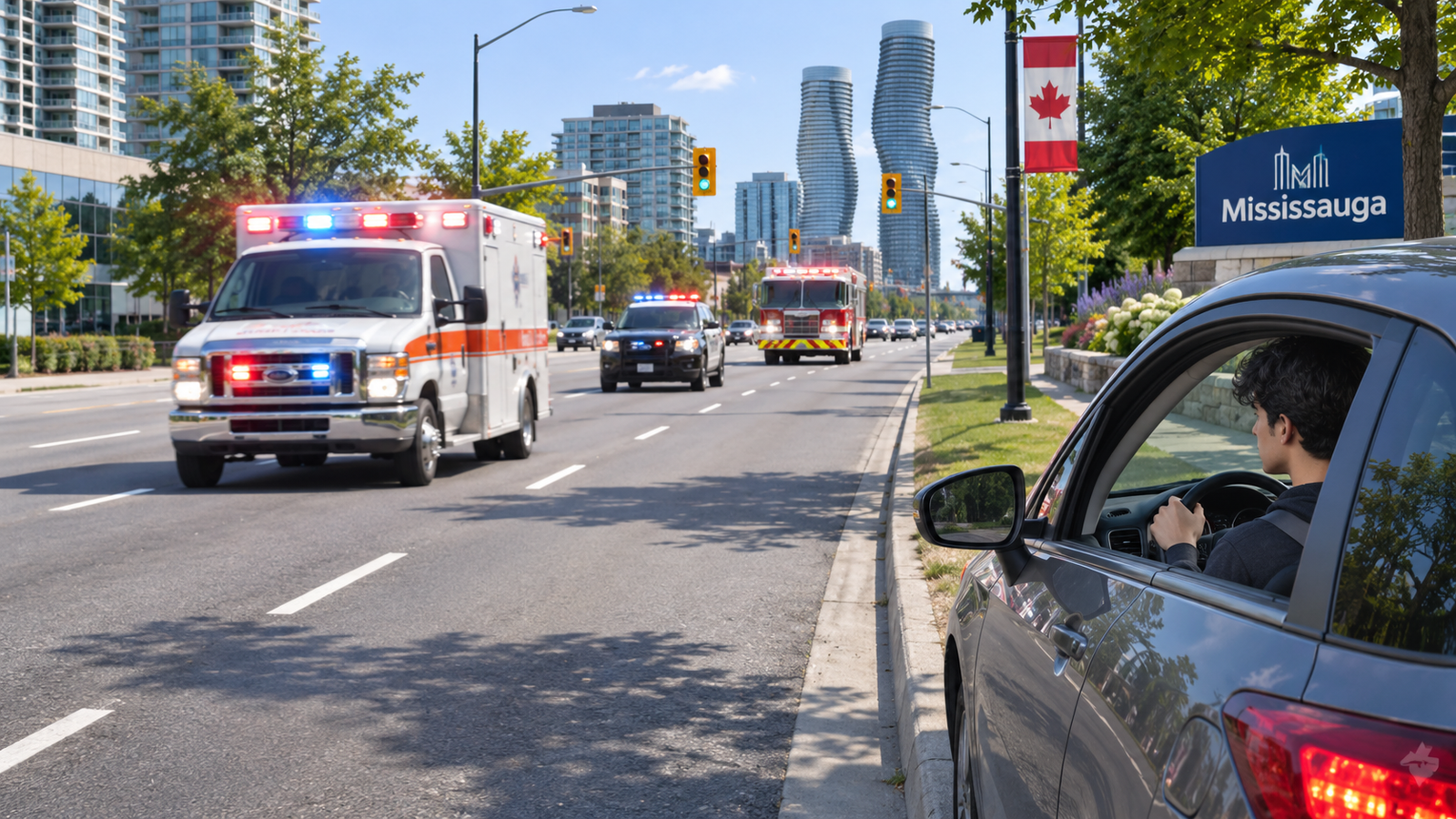
It can be difficult for a beginner to drive in Mississauga, especially when an ambulance, police car or fire truck is coming by with flashing lights and sirens. In heavy traffic, busy crossroads and new road conditions, inexperienced drivers may have problems.
Safe driving means knowing how to respond to emergency vehicles. Ontario’s traffic code requires drivers to give way to emergency personnel.
By following these guidelines, you can stay safe on Mississauga’s roads, no matter if you have a G1 or G2 license or just got your full license.
Understanding Right of Way for Emergency Vehicles
Emergency vehicles respond to calls for accidents, fires, medical problems and other emergencies. These are the usual Mississauga emergency vehicles:
- Police cars are dispatched to accidents, emergencies and public safety incidents.
- Patients are provided emergency care and transported by ambulance.
- Fire trucks: Respond to emergencies, fight and rescue.
In a crisis, the cars use their lights and sirens to warn other drivers.
In Ontario you are supposed to yield to emergency vehicles with flashing lights. Incorrect replies can delay emergency help and put lives at risk.
How to react when an emergency vehicle appears?
New drivers should be cool and follow a regular procedure when an emergency vehicle is approaching.
Keep Calm and Check Your Surroundings
Do not panic or brake when flashing emergency lights or sirens.
Look in your mirrors and traffic to see where the emergency vehicle is coming from.
Remember other cars may be pulling up. Sudden movements have added dangers.
Signal safely, pull over and stop.
Ontario Ministry of Transportation says slow down, signal, move right and stop clear of junctions
In reply:
- Slow down without using the brake.
- Look in the mirrors and blind spots.
- Indicate your transfer.
- Pull over to the right side of the road.
- Pull over for emergency vehicles.
On some one-way and split roadways, move to the closest safe edge. Block no crossroads, highway ramps, or emergency access routes.
Resume driving when it is safe to do so.
Don’t speed up until the emergency vehicle has passed.
Watch traffic , signal , and safely merge back into the route . Look for oncoming emergency vehicles .
What to do when you see emergency vehicles at intersections and traffic lights
Intersections can be tricky when emergency vehicles are coming.
Don’t run the red light to create space. Running a red light could hit other cars or people crossing.
Stay stopped until you can legally move or are told to by a police officer.
If you are in an intersection when an emergency vehicle arrives, drive straight ahead when safe. Then pull to the right and stop. Don’t turn left, into the way of the emergency vehicle.
New drivers in Mississauga should be prepared to see emergency vehicles move at certain crossings including Hurontario Street, Dundas Street and Burnhamthorpe Road.
Ontario’s Move Over Law: What You Should Know
Ontario’s Move Over law protects emergency responders and tow truck operators working along active roads.
This law is for stopped cars, not cars approaching emergency vehicles.
What is the Move Over Law?
- Slow down and proceed with caution when approaching a stopped emergency vehicle with activated lights.
- On two-lane roads, cars must change lanes when it is safe to leave a clearance lane.
- Check mirrors, signal and check for adequate space before changing lanes.
Are Tow Trucks Covered by the Law?
Yes, Ontario’s Move Over laws apply to stopped tow trucks with flashing amber lights.
Tow truck drivers may assist stranded motorists or recover damaged vehicles, sometimes working near traffic.
The slowing down and creating a safe distance for roadside workers increases their safety.
Penalties Breaking the Rules
Ontario’s emergency vehicle rules have hefty fines for non-compliance.
Sanctions for first-time offense include:
| Penalty Type | Details |
| Fine | The fines ranged from $400 to $2,000. |
| Demerit Points | Three demerits if found guilty. |
| License | Driver’s license may be revoked for two years. |
If the offense is committed again within five years, the penalty can be a fine of $1,000 to $4,000, jail time and suspension of the license.
This implies that new drivers need to be aware of legislation surrounding emergency vehicles.
Drive Around Emergency Vehicles on Busy Roads in Mississauga
Mississauga has roads, businesses and homes. Different environments have different issues.
Major City Road Response
Hurontario, Dundas and Burnhamthorpe roads are very busy during commutes.
When an emergency vehicle approaches, drivers should not change lanes or stop suddenly.
Watch for cars, pedestrians and bikes. Don’t be an inconvenience to others. Give way for your own safety.
Emergency Highway Vehicles
Many Mississauga drivers use highways 401, 403 and the Queen Elizabeth Way.
The faster you go the more vital a good reaction is.
If an emergency vehicle is coming, slow down and pull to the roadside when it is safe to do so. Keep the shoulder of the highway open for emergency personnel to get through traffic.
When approaching a stopped emergency vehicle, follow Move Over laws and change lanes only when safe.
Mistakes new drivers make around emergency vehicles
Bad decisions by inexperienced drivers because they don’t know the right answer.
Frequent errors:
- Sudden braking can lead to a rear-end accident.
- Loud music or distractions could cause emergency cars to be missed.
- Stopping at an intersection can get in the way of an emergency vehicle.
- Accidents can happen if you change lanes without checking your mirrors and blind spots.
- Following an ambulance or fire truck too closely can be dangerous. In Ontario it is illegal to follow a fire truck or ambulance within 150 meters
- Copying other drivers: Obey traffic laws and do not assume that other drivers will be safe.
Awareness of these faults will help novice drivers improve their judgment and safety.
How driving lessons get new drivers ready for emergencies
Traffic laws are important, but applying them to real driving situations takes practice.
Professional driving courses teach new drivers skills such as:
- Awareness of traffic.
- Change lanes and brake safely.
- Recognition of road dangers.
- Ontario Traffic Laws Explained
- Make judgments Be cool under pressure
Mississauga professional driving education can teach students how to handle local crossings, multilane highways and highway traffic.
Driving schools such as The Driving Tutors may instruct new drivers in road awareness and defensive driving techniques for making safer decisions in unforeseen circumstances.
Frequently Asked Questions
Ontario: Do You Have to Stop for an Ambulance?
Yes. Drivers should give way to ambulances using their emergency lights or sirens by pulling over to the side of the road and stopping safely, and not entering junctions.
If an emergency vehicle is approaching me at a red light, what should I do?
Don’t wait in the junction at a red light to make room. Be alert, keep your distance where safe and legal, and obey police directions for traffic.
Will You Be Fined in Ontario for Not Pulling Over for an Emergency Vehicle?
Yes . Failure to comply with the emergency vehicle standards in Ontario could result in fines, penalty points or a driver’s licence suspension.
Do you have to give way to emergency vehicles on a divided highway?
Drivers have to react to emergency vehicles. When driving on divided highways, use the shoulder edge, avoid interchanges and ramps, don’t block shoulders.
May You Follow an Ambulance or Fire Truck in Traffic?
No, Ontario law says you can’t tailgate an emergency fire truck or ambulance closer than 150 meters. Keep a safe distance and obey traffic signals.
Conclusion: Watch Out and Give Way to Emergency Vehicles
Every new Mississauga driver needs to know how to handle emergency vehicles.
Staying alert and following Ontario’s driving laws can stop accidents and help emergency personnel reach their destinations faster on busy city streets or Highway 401.
New drivers should remain calm, observe the traffic, signal and give way to emergency vehicles.
With regular practice and expert instruction in driving, one can gain confidence and become a responsible driver.
Drive safe, for more than just your own sake. It also means making the route safer for emergency responders and others.